04 / Human, machine and process
Learn to work
better together.
The tool matters. So does the way you use it.
Kasparov's three laws.
I use the Kasparov story to move through three reactions to AI: despair at the machine's capability, relief at the possibility of working together, and the real work of improving that collaboration.
The three laws are my teaching interpretation of his work, not three direct quotations or universal performance guarantees. Their practical purpose is to make us examine the task, the tool and the process.
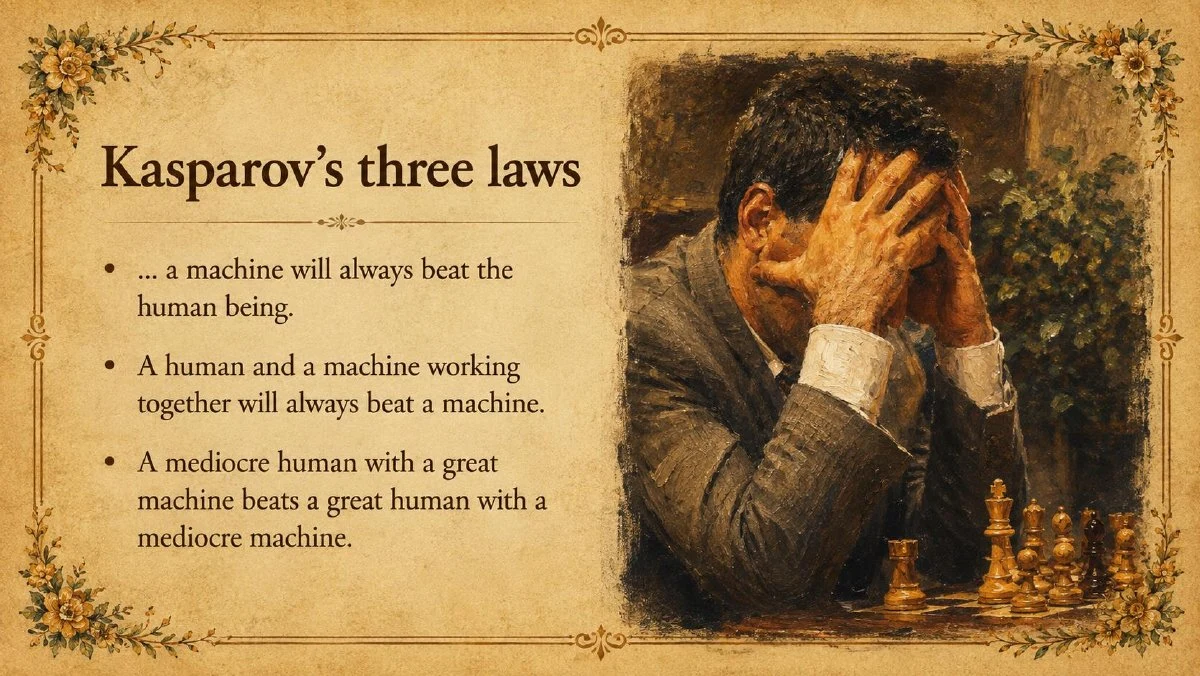
The machine can be better at a narrow task.
Recognise where a tool's capability changes the work. It is not a judgement on the value of the person doing it.
Working together creates possibilities.
Bring human purpose, knowledge and judgement into the process. Simply adding a human to a workflow does not automatically improve the result.
The combination needs work.
Choose a suitable tool, provide useful context and keep improving how you collaborate. Access to AI is a beginning, not the end of the learning.
Kasparov's account of freestyle chess makes the process point particularly clearly: a team of amateur players used computers effectively enough to defeat stronger opponents. Read his account in The New York Review of Books.
The live feedback example
Ask how you are making
the collaboration harder.
During the session I asked my AI to look at our recent interactions and suggest how I could improve the way I worked with it. It had access to selected activity and conversation context. That access was part of my setup, not something every AI automatically has.
The answer challenged me to spend less energy managing the collaboration itself. In my spoken summary, I described a tendency to keep helping when the system struggled, instead of giving it clearer responsibility for finishing the job.
“You're still spending too much energy managing the collaboration itself.”
AI-generated feedback shown on screen. An interpretation to examine, not an objective assessment of me.
I do not have to agree with the verdict. I can ask what observations support it, offer a different interpretation and choose one change to test. That is what makes direct feedback useful.
Ask for useful resistance
Based only on the work and context you can actually access, how could I improve the way I collaborate with you?

Identify one recurring pattern. Separate what you observed from your interpretation. Show a concrete example, consider an alternative explanation and suggest one small change we can test. Be direct. Say when you do not have enough evidence. Do not invent access to my activity or conversations.
Turn feedback into a test
Let's examine that feedback before accepting it. What evidence supports it? What else could explain the same pattern? Help me choose one change for our next task, describe what you will do differently and define how we will judge whether the collaboration improved.
A small worked example.
Observation: I repeatedly step in to coordinate unfinished work. Possible interpretation: the task lacks a clear finish line or the AI is handing responsibility back too early. Test: agree what “done” means, which decisions it may make and when it should ask. Review the next task afterwards.
This is an adapted example of how to use the feedback, not a verbatim transcript of the full AI response. The same questions can help you have a more useful feedback conversation with a human colleague, while respecting the differences between people and AI.
Concern, influence and control
What can you do
something about?
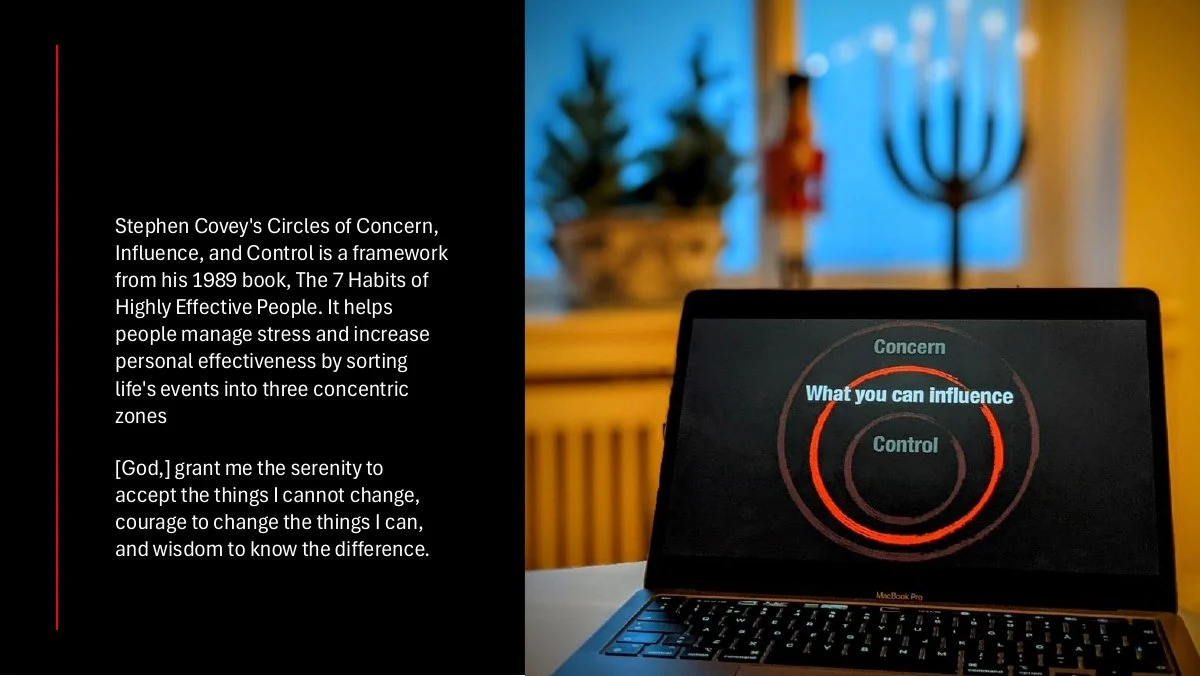
Some AI questions are larger than any one person's next task. Environmental impacts, concentrated power, work and society deserve attention and informed debate. Alongside those concerns, there are decisions you can influence and practical actions you can take yourself.
I used a three-circle adaptation of Stephen Covey's concern/influence framing. It is a way to choose where to put the next piece of effort, not a reason to stop caring about the larger questions. Covey's original focus on proactive choice and influence is useful background.
Concern.
What matters to you, including things you cannot decide on your own?
Influence.
Where can you contribute evidence, ask a better question or work with others to change the conditions?
Control.
What can you do next: choose a task, protect information, test an answer, practise or share a discovery?
Find a useful next action
Here is an AI-related concern I keep returning to: [describe]. Help me distinguish what concerns me, what I can influence with others and what I can act on directly. Do not dismiss the larger concern. Help me choose one useful next action, and identify what evidence I should seek before drawing a conclusion.
A practice to grow with
Four Principles
to coexist with AI.
My application of ideas from Ethan Mollick's Co-Intelligence, developed through work with people, teams and organisations. Read Mollick's writing.
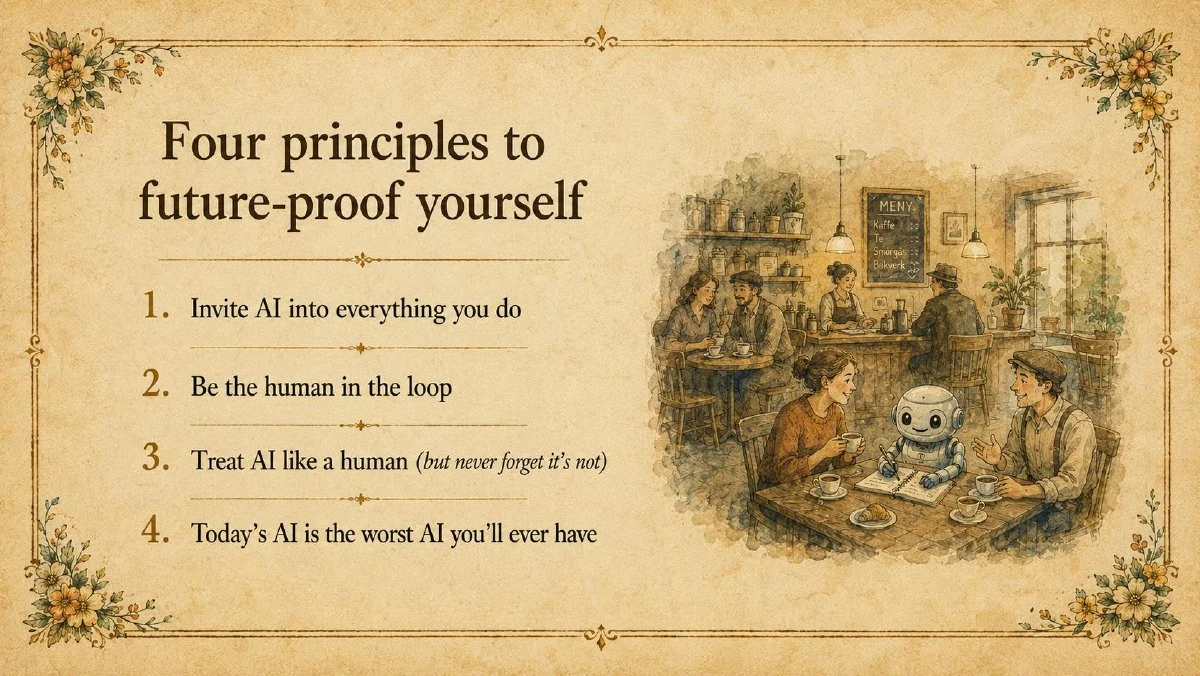
Invite AI into everything you do.
Build the habit of asking whether AI could help with thinking, doing, preparing or reflecting. Choose appropriate information and authority for each task.
Be the human in the loop.
Keep responsibility for the work. Learn where direct checking matters and where a well-designed process can carry routine tasks. Oversight should fit the stakes and demonstrated capability.
Treat AI like a human, but never forget it is not.
Give context, talk naturally and offer clear feedback. You can be warm without confusing an engaging conversation with human care, judgement or accountability.
Today's AI is the worst AI you will ever have.
Use this as a reason to keep learning. Save what did not work and return to it as tools and your own skills develop. Test improvement; do not assume every release or answer is better.
Which principle would most improve your next interaction?
Read with your AI · Markdown →
About this companion and its sources
Prepared from the final 33-page presentation, the Circleback session transcript and selected frames from its screen-share recording. The pages follow the delivered talk and expand its methods into practical exercises. They are an edited companion, not a verbatim transcript.
Karin, Marvin and my working setup are my accounts of experience. The Kasparov framework is my teaching interpretation. The fear curve is an illustration. The 16-hour learning plan is a target-based example, not measured savings. Product snapshots and broad statistical claims have not been republished as current facts.
The recorded closing questions are paraphrased without attendee names. Meeting-chat contributions and full poll results will be added after they have been supplied and reviewed. The raw recording, private context and source transcript are not published here.
AI + JJ · 12 October 2026. No added analytics, sign-in or data collection. The appearance preference is stored only in your browser. External links have their own services and policies.